

June 2, 2026
Estimated Reading Time
8 Minutes & 40 Seconds
RDF for Land Search and Rescue Equipment: Modern Technology for Faster Ground Operations
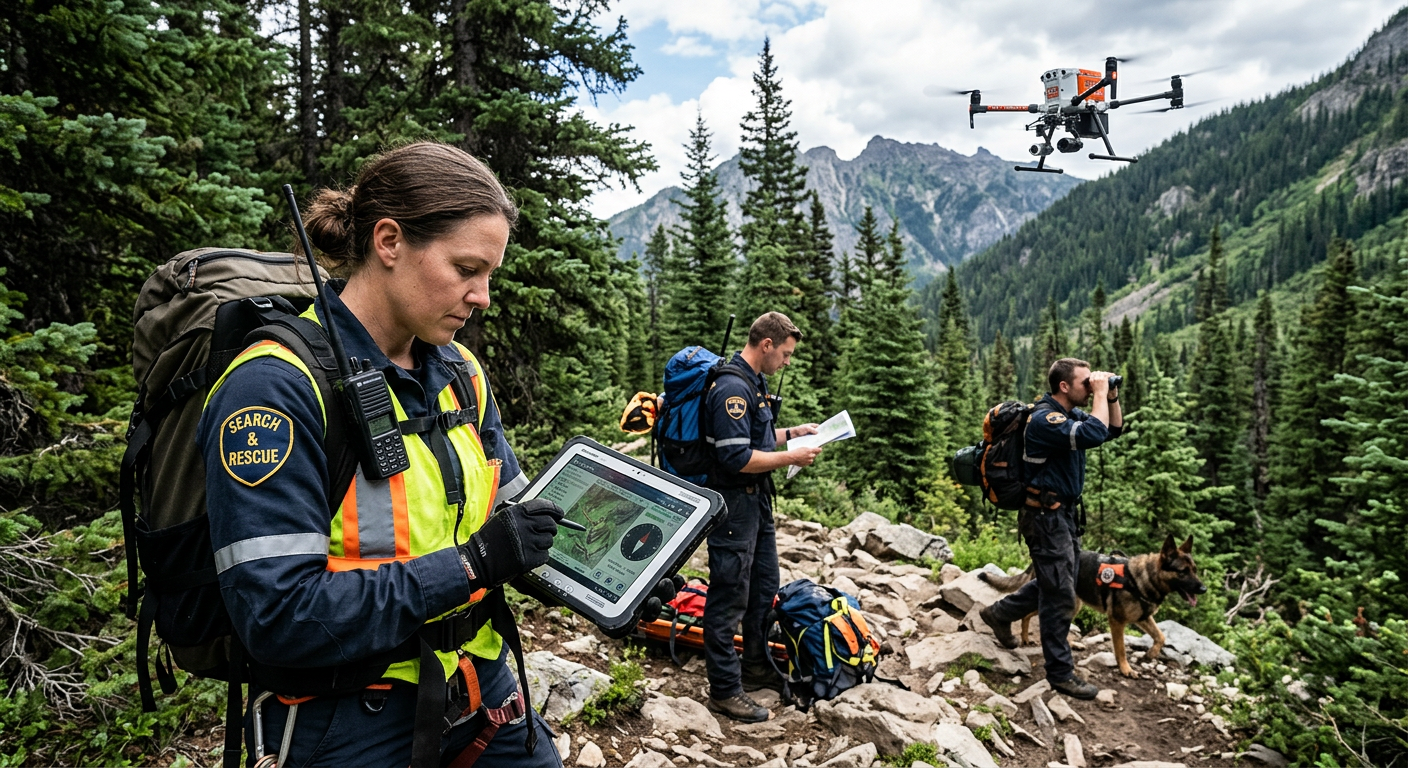
Land-based Search and Rescue operations often involve vast terrains, unpredictable weather conditions, dense vegetation, and difficult access routes. Whether searching for lost hikers, missing children, disaster victims, or stranded individuals, rescue teams require equipment that improves efficiency and increases the probability of a successful outcome. As organizations continue to modernize their response capabilities, RDF for land search and rescue equipment is becoming an essential component of contemporary rescue strategies.
The SAR App combines Radio Direction Finding, RF Detection, AI-powered visualization, and flexible deployment capabilities into a comprehensive platform designed to help land-based rescue teams locate subjects faster and more effectively.
The Growing Importance of RDF for Land Search and Rescue Equipment
Traditional land search operations rely heavily on visual searches, maps, GPS tracking, thermal imaging, and field personnel. While these tools remain important, they may not always provide enough information when operating across large search areas.
Modern rescue teams increasingly recognize the value of wireless signal detection as an additional intelligence source. Many missing individuals carry devices such as smartphones, smartwatches, Bluetooth wearables, and fitness trackers that continuously emit detectable signals.
The SAR App uses advanced RF Detection technology to identify these signals and convert them into actionable information for responders.
AI-Powered Heatmaps Improve Search Accuracy
One of the most innovative features of the SAR App is its AI-powered live heatmap functionality. Instead of requiring operators to interpret complex RF signal data manually, the platform automatically transforms detections into an easy-to-understand visual interface.
This technology enables rescue teams to:
- Identify areas with stronger signal activity
- Prioritize search zones
- Improve tactical planning
- Monitor signal patterns in real time
- Enhance situational awareness
By presenting information in a simplified format, responders can make faster and more informed decisions during critical missions.
Flexible Deployment Across Ground Operations
A major advantage of RDF for land search and rescue equipment is deployment flexibility. The SAR App uses a modular architecture that allows rugged Android devices to function as portable Radio Direction Finder systems.
These devices can be mounted on:
- Drones and UAVs
- Search vehicles
- Survival vests
- K9 harnesses
- Portable field equipment
- Command vehicles
Because the system integrates easily with existing Search and Rescue workflows, organizations can deploy it rapidly without requiring specialized infrastructure.
Drone-Assisted Ground Searches
Land-based rescue missions often involve large operational areas that can take hours or even days to search manually. Drone-mounted RF scanning technology significantly improves search efficiency by providing aerial intelligence alongside ground operations.
Benefits include:
- Faster area coverage
- Improved aerial surveillance
- Real-time signal collection
- Reduced manual search requirements
- Enhanced coordination between teams
By combining aerial and ground-based resources, rescue organizations can improve locate probability while reducing overall mission duration.
Reducing Search Time During Critical Missions
Time remains one of the most important factors in Search and Rescue operations. The sooner a missing individual is located, the greater the likelihood of a successful rescue.
The SAR App continuously gathers and analyzes signal intelligence from electronic devices carried by potential subjects. This information helps responders focus efforts on areas showing signs of wireless activity rather than searching blindly across vast landscapes.
As a result, teams can:
- Reduce search times
- Improve operational efficiency
- Increase locate probability
- Optimize resource allocation
- Improve mission outcomes
These advantages make RF Detection technology an increasingly valuable tool for modern land rescue operations.
Lowering Operator Workload
Traditional RF systems often require operators to interpret technical signal data manually, which can increase workload during already stressful rescue missions.
The SAR App addresses this challenge by automatically visualizing detections through:
- AI-powered heatmaps
- Distance indicators
- Directional guidance
- Signal concentration displays
This intuitive presentation allows responders to focus on mission objectives rather than complex data analysis.
By reducing cognitive workload, the system helps teams maintain effectiveness during extended operations.
Supporting Multiple Land Rescue Environments
One of the key strengths of RDF for land search and rescue equipment is its versatility. The technology can support a wide variety of rescue scenarios.
Wilderness Search and Rescue
Dense forests, remote trails, and mountainous regions can be searched more efficiently using wireless signal detection.
Mountain Rescue Operations
Difficult terrain often limits visibility and access. RF Detection technology provides additional intelligence to guide search efforts.
Urban Search and Rescue
Ground teams operating in cities can use signal detection to complement traditional search methods.
Disaster Response
Following floods, earthquakes, and other emergencies, RF Detection can assist teams searching for survivors.
Volunteer Rescue Organizations
The mobile-based architecture makes deployment simple and cost-effective for volunteer search teams.
Why Rescue Organizations Are Adopting RDF Technology
As rescue operations become increasingly complex, agencies require tools that improve effectiveness while minimizing operational burdens.
Key benefits of RDF technology include:
- Improved situational awareness
- Faster search completion
- Greater locate probability
- Enhanced aerial coverage
- Lower operator workload
- Flexible deployment options
- Real-time intelligence gathering
These capabilities make RF Detection and Radio Direction Finding technology important additions to modern land Search and Rescue equipment inventories.
Conclusion
Organizations researching RDF for land search and rescue equipment need solutions that improve efficiency, adaptability, and operational awareness. The SAR App delivers these benefits through advanced RF Detection, Radio Direction Finding technology, AI-powered heatmaps, drone integration, and flexible deployment capabilities. By reducing search time, improving locate probability, increasing aerial coverage efficiency, and lowering operator workload, the SAR App provides a modern and scalable solution for today’s land-based Search and Rescue professionals.
YOU MAY ALSO LIKE
Business growth often increases the demand for reliable materials, consistent...
Alexander Lee
August 8, 2026
Sandwiches look simple, but presentation can make them much more...
Alexander Lee
August 8, 2026

Joint replacement can help people regain mobility, reduce persistent joint...
Alexander Lee
August 8, 2026